whatmarriagedidnext.
blogspot.com

love, commitment and parenting have a new home
Showing posts with label innovation. Show all posts

Saturday, October 4, 2008

Seth Godin on selling new ideas

How to Sell a Book (or Any New Idea) (step 1 is the hard part) is the title of an excellent eight-slide presentation from Seth Godin on ChangeThis.
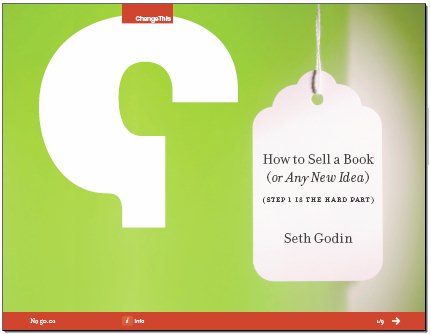
Here's a sample quote ...


My friend Fred has a new book coming out and he was trolling around for new marketing ideas. I think he’d be surprised at this:
Sell one.
Find one person who trusts you and sell him a copy. Does he love it? Is he excited about it? Excited enough to tell ten friends because it helps them, not because it helps you?

More from Seth:

Tribes grow when people recruit other people. That’s how ideas spread as well. They don’t do it for you, of course. They do it for each other. Leadership is the art of giving people a platform for spreading ideas that work. If Fred’s book spreads, then he’s off to a great start. If it doesn’t, he needs a new book.

This bit is important:

You don’t get to take step 2 if you can’t do step 1.

And finally - you'll need to view the slides to get this:

What’s hard now is breaking the rules. Successful people are the ones who are good at this.

Go download How to Sell a Book (or Any New Idea) (step 1 is the hard part).


Read more!

Sunday, June 29, 2008

Happiness is your business model

Check out this inspiring presentation by Tara Hunt with the title of Happiness is Your Business Model.

What are the conditions for human happiness? Tara cites the American Psychological Association’s list of four:

  • Autonomy — in control of life
  • Competence — ability to do stuff
  • Relatedness — interaction with others
  • Self-esteem — confidence in self

And the main barriers to achieving happiness?

  • Fear
  • Confusion
  • Loneliness
  • Lack of control
  • Struggle for survival

Without further ado here then is Tara’s presentation:

Also check out Tara's post The Axis of Misery.


Read more!

Wednesday, June 25, 2008

New marriage, new thinking

‘Is anyone else thinking what we’re thinking?’

That’s a question we asked ourselves when we first developed the idea, back in mid-2006, of marriage based not on family law but on contract law.

Sure enough we found that a number of innovative thinkers had been seeking a new basis for marriage and parenting outside the family law system.

Among them were writers, legal scholars, academics – even a Nobel-prize winning professor!


In our slideshare slideshow, entitled New Thinking, New Marriage, we've brought together a collection of thoughts from some eminent individuals who are re-thinking marriage for the 21st century.

Our slideshow has been online for about ten months now and in that time it has received 1,600+ hits. Got a comment or feedback you would like to share? We would love to hear from you


Read more!

Innovation in partnering, parenting

Jeremy Gutsche said it right. As CEO of TrendHunter.com, a global network that tracks and anticipates innovation in areas such as pop culture, fashion, technology, art and lifestyle, Jeremy knows where to look when seeking to find innovation.

In every industry innovation starts by observing customers

You can check out Jeremy's insightful Slideshare presentation below.


In the realms of partnering and parenting one social trend is clear: the three-decade long replacement of marriage with cohabitation. In the UK, for example:

  • The number of cohabiting couples increased by two-thirds over the decade 1996-2006, and by 2031 the number will double to 3.8 million.
  • Cohabiting couples and single-parent households will outnumber married couples by 2014.

But not all ‘customers’ are the same. According to the diffusion of innovations theory developed by Everett M. Rogers, consumers can be grouped according to how quickly they adopt a new product, service or idea.

Thirty years ago, couples living together outside marriage were regarded as ‘visionaries’; ten years ago, as ‘early adopters’; now, in every developed country, cohabiting couples are the ‘early majority’.

In every developed country, it is not couples married to each other but partners living together that form the fastest-growing family type.

Cohabiting couples: from non-marriage to new marriage

Once cohabitation was merely the absence of marriage; now, slowly but surely, it is becoming a search for a new marriage. The first steps across the bridge from non-marriage to new marriage is the so-called 'cohabitation contract': a legal agreement, defined by the couple, that sets out their responsibilities to one another.

In June 2007 I took a screenshot of a Google search for 'cohabitation contract'. The number of results found was 793. Just twelve months later the number has more than trebled to 2,690.


What family law has taken out of marriage – mutual commitment – a still-small but fast-growing number of couples are putting back in. In innovation terms, they are the relationship ‘innovators’. Soon the ‘early adopters’ will join them, to be followed by the ‘early majority’.

The path to WeDo Marriage

But a cohabitation contract is just the first step towards a new marriage; to complete the transition, something more is needed: the wholesale rebuilding, outside the family law system, of a marriage that meets the description so eloquently expressed below by Professor Linda J. Waite.


Read more!

Tuesday, June 24, 2008

Making meaning, building success

Do you believe in your work? If not, why do it? If it’s routine or empty, or doesn’t challenge you to live up to your potential – then what’s the point?

In our view no one has better made the connection between work and motivation than Guy Kawasaki: entrepreneur, investment banker, venture capitalist and author.

The core of entrepreneurship is to make meaning. Those companies that are fundamentally founded to change the world – to make meaning – are the companies that make a difference, the companies that succeed.


So what is this ‘meaning’ all about then, Guy?

Making meaning is the most powerful motivator there is. (But) meaning is not about money, power, or prestige. It’s not even about creating a fun place to work.
       Among the meanings of ‘meaning’ are: to make the world a better place; to increase the quality of life; to right a terrible wrong; and to prevent the end of something good.

Preventing the end of something good

Every survey and opinion poll tells us that today’s couples still seek marriage. As an idea, a sought-after goal, marriage is not dead but is still very much alive.

But the choices today's couples are making in their lives also tell us something else: they want marriage. They just don’t want the only version of marriage that’s available from the only people who currently supply it: the family law system.

If marriage is to have a future then it can only be outside the family law system, for the past tells us that marriage certainly has no future within it. What is called family law has 'protected' marriage to death. Life will come back to marriage when couples are enabled to create marriages that are protected from the family law system.


From The Art of Start by Guy Kawasaki on YouTube.


Read more!